
- Final holes intersect strong phyllic alteration, increasing sulphide intensity, visible galena and localized massive sulphide mineralization; assays pending
Vancouver, British Columbia – June 3, 2026 – Viscount Mining Corp. (“Viscount” or the “Company”) (TSX VENTURE: VML) (OTCQX: VLMGF) is pleased to announce completion of the first phase of the core drill campaign at the Silver Cliff Project in Colorado, where the final four drill holes (K26-05 through K26-08) encountered widespread hydrothermal alteration, brecciation, manganese-oxide mineralization, strong sulphide mineralization with increasing intensity, visible galena and localized massive sulphide veining north of the Kate Resource area. The Company believes these results support its interpretation that the mineralized hydrothermal system at Silver Cliff extends beyond the current Kate Silver resource area and northward toward the Passiflora porphyry target and the Ben West volcanic complex, potentially indicating proximity to a larger mineralized system.
Notably, hole K26-08 intersected a localized massive-sulphide vein together with visible galena and possible chalcopyrite, associated with strong pyrite mineralization and alteration. All mineralization described in this release is based on visual examination of drill core only. Assays for the 2026 program are pending. Visual estimates are inherently imprecise, are not a substitute for laboratory assays, and should not be relied upon as an indication of grade or economic mineralization (see “Cautionary Note Regarding Visual Estimates” below).
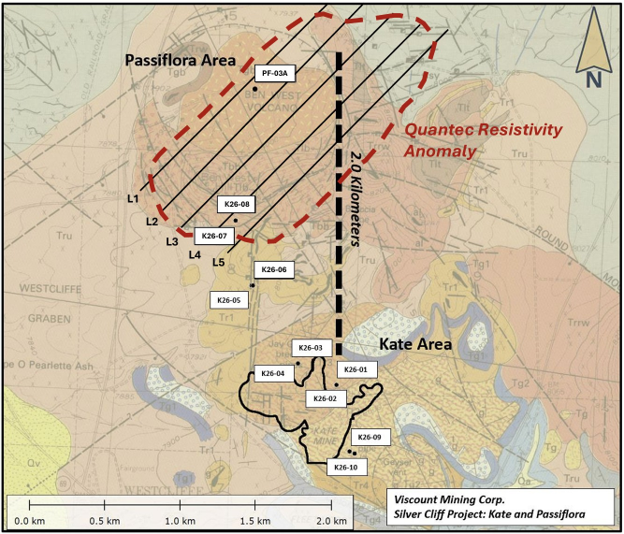
Figure 1. Silver Cliff drill hole location and area map.
2026 Program Highlights
- Completed four final holes (K26-05 to K26-08) testing both resource-expansion targets around the Kate deposit and new district-scale structural targets to the north.
- Intersected multiple zones of phyllic alteration, silicification and hydrothermal brecciation along major structural corridors.
- Observed visually increasing sulphide intensity with depth, including a localized massive-sulphide vein in hole K26-08.
- Identified visible galena and possible chalcopyrite in K26-08, consistent with the Company’s base-metal and porphyry-related exploration model.
- Assays for all holes are pending and will be released once received, compiled and interpreted.
Jim MacKenzie, CEO and Director stated “These final holes significantly strengthened our belief that Silver Cliff hosts a large-scale mineralized hydrothermal system extending well beyond the current Kate resource area. The increasing sulphide intensity, strong alteration and localized massive sulphide mineralization encountered in K26-08 are particularly encouraging and may indicate we are vectoring toward a more robust mineralized center associated with the Passiflora target. With assays pending and geophysics now underway, we believe Silver Cliff continues to demonstrate meaningful district-scale discovery potential.
Final Four Holes
The final four core holes of the Kate drill program were designed to test two anomalies identified during the soil survey north of the Kate Silver resource area. This area has historically received very limited attention, despite its proximity to the historic Defender mine, a past producer of lead and silver. The first two holes (K26-05 and K26-06) tested the more southerly soil anomaly, while the final two holes (K26-07 and K26-08) tested a strong anomaly located in the north-west corner of the soil survey.
Hole-by-Hole Summary
Hole K26-05 — Structural Corridor Target (Completed Depth: 276 feet / 84.1 metres)
K26-05 was designed to test a major north–south structural corridor north of the Kate resource, near Colorado Quarry Road. The hole intersected broken to brecciated rhyolite with manganese-oxide, limonite and hematite staining associated with multiple fracture sets, before transitioning into a strongly altered phyllic zone characterized by silicification, angular hydrothermal-breccia textures and finely disseminated sulphides.
The Company notes that phyllic alteration of this type is commonly associated with porphyry-related hydrothermal systems and is comparable to alteration’s observed near the historic Passiflora and Defender mines in the Silver Cliff district. The hole terminated at 276 feet (84 metres) while remaining within the alteration zone.
It was drilled to the north along a north-trending fault zone that hosts three shafts along trend. The hole encountered very muddy overburden from surface to approximately 14 feet, below which competent rock was intersected. The core contained a few breccia zones together with disseminated sulphides visually estimated at approximately 8% to 15% over its 276-foot (84-metre) length (visual estimate only — not an assay).
Hole K26-06 — Follow-Up Structural Test (Completed Depth: 300 feet / 91.4 metres)
K26-06 was drilled as a follow-up along the same north–south structural corridor. Due to significant near-surface clay alteration, the Company adjusted the drill orientation to better penetrate the target zone. The hole intersected persistent phyllic alteration, brecciation and finely disseminated pyrite over substantial intervals, consistent with a broad hydrothermal alteration system extending northward from the Kate resource.
It was drilled to the north-west from the same drill location and showed phyllic alteration. The intensity of the alteration diminished as the hole progressed, which the Company interprets as the hole becoming more distal to the heat source.
Hole K26-07 — Ben West Volcanic Rim Target (Completed Depth: 500 feet / 152.4 metres)
K26-07 tested the southern rim of the Ben West volcanic complex within the Miocene-aged Tbb rim-breccia unit. The hole provided important geological information on the volcanic and structural architecture linking the Kate and Passiflora areas. The Company believes the Ben West complex may represent a hydrothermal centre capable of focusing mineralizing fluids across the district.
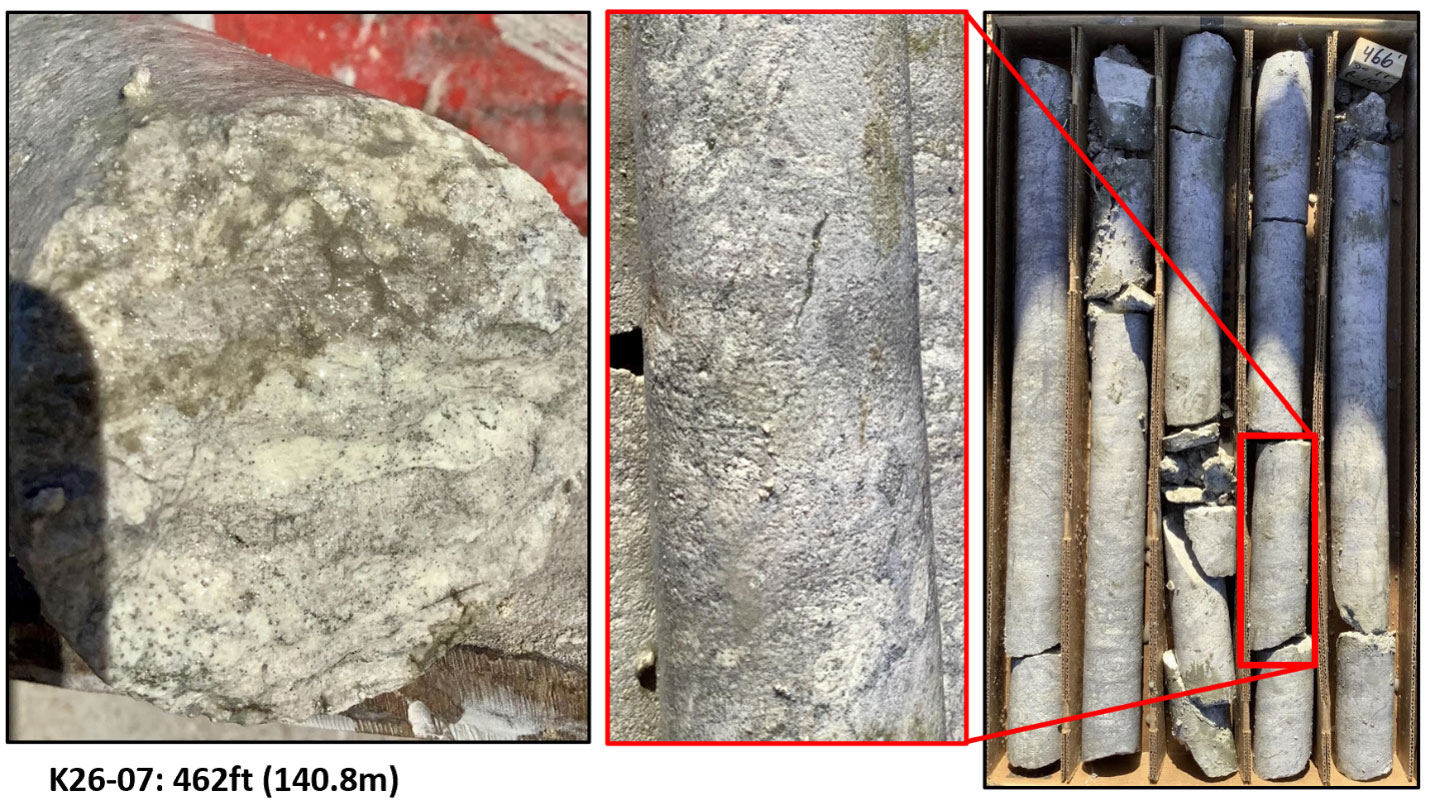
K26-07 and K26-08 were drilled to test the strongest soil anomaly, located in the north-west corner of the soil survey. K26-07 was drilled vertically. The hole intersected the volcanic rim breccia and exhibited strong phyllic alteration, with some sulphide zones logged as almost solid.
Hole K26-08 — Increasing Sulphide Intensity and solid pyrite veins (Completed Depth: 500 feet / 152.4 metres)
K26-08 was among the most geologically encouraging holes of the 2026 program. Drilling encountered a distinct oxidized-to-unoxidized transition at approximately 68 feet (20.7 metres), below which the visual intensity of sulphide mineralization increased substantially. Logged features include
- Increasing sulphide intensity with depth
- Visible galena and possible chalcopyrite
- Sulphide-rich breccia zones
- A localized massive sulphide vein at depth
- Strong phyllic alteration associated with major structural corridors
- A localized solid pyrite vein approximately one foot (0.3 metres) in length at approximately 486 feet (148.1 metres)
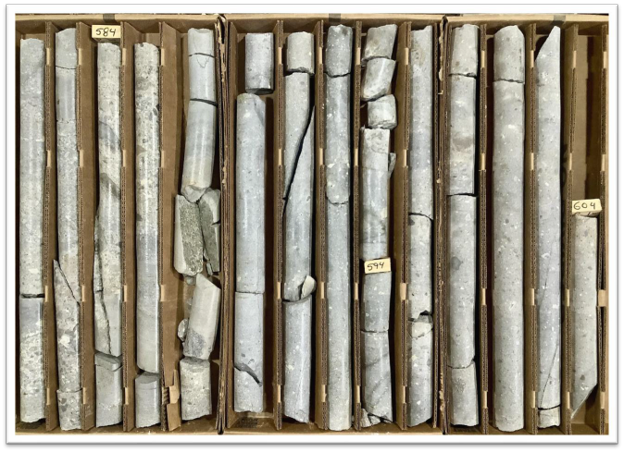
Figure 3. K28-08 core photo starting at 578 to 604ftTD (176.2 – 184.1m). The rock can be described as blocky to competent, variable medium gray, felsic to intermediate in composition, local breccia textures, skinny bands of massive pyritic sulfide locally, finely disseminated brassy pyritic sulfide more common, also occurring along select fractures, blebby to stringer (>15%).
With increasing depth, sulphides were observed visually as disseminations, fracture-fill, stringers, blebs and localized massive-sulphide veins. The Company believes these features may reflect increasing proximity to a more strongly mineralized portion of the system. As noted above, these are visual observations only and remain subject to confirmation by assay.
K26-08 was originally planned to be drilled to the north-west; however, following the results of K26-07, the hole was instead drilled toward the north-east. Like K26-07, it intersected the volcanic rim breccia and exhibited strong phyllic alteration, with some sulphide zones logged as almost solid. The hole also intersected metallic-looking crystals that were not identified in the field; these are expected to be identifiable once geochemical results are received.
Given the strong gold and silver values returned from soil sampling in this area, the Company believes the pyrite may be the host for gold and silver. This is a preliminary interpretation based on visual core logging and soil geochemistry only; it has not been confirmed by assay of the drill core, which is pending.
Geological Interpretation
The 2026 drill program indicates that hydrothermal alteration and visible mineralization extend beyond the current Kate Silver resource boundary and continue northward toward the Passiflora area and the Ben West volcanic complex. Across multiple holes, targeting expansion potential north of the Kate Resource the program intersected:
- broad zones of phyllic alteration, silicification and hydrothermal brecciation
- Observed increasing sulphide intensity with depth across multiple holes
- Hole K26-08 encountered visible galena, possible chalcopyrite and localized pyrite veins
- Geological indicators suggest vectoring toward a larger mineralized system associated with the Passiflora target
- Assays pending for all holes
The Company believes these characteristics are consistent with a vertically and laterally extensive hydrothermal system with the potential to host both near-surface silver mineralization and deeper porphyry-related mineralization. This interpretation is preliminary and based on visual core logging; it has not been confirmed by assay results or by a mineral resource estimate. Assays from the 2026 holes are pending and will be released once received, compiled and interpreted.
Cautionary Note Regarding Visual Estimates
Readers are cautioned that the descriptions of mineralization in this news release are based on visual observation and visual estimates from drill core only. Visual estimates of mineral or sulphide abundance are inherently imprecise and unreliable as a measure of grade. Mineralization observed in drill core may not be representative of mineralization on the property, and the presence of sulphides, galena, chalcopyrite or other minerals does not necessarily indicate the presence of economically recoverable mineralization. No assay or analytical results are available for the 2026 drill holes as at the date of this news release. The Company cautions that visual estimates should not be relied upon and that actual grades, widths and continuity of mineralization can only be determined by laboratory assay of sampled drill core, which is pending.
True widths of the intervals described have not been determined, and reported lengths are downhole (core) lengths.
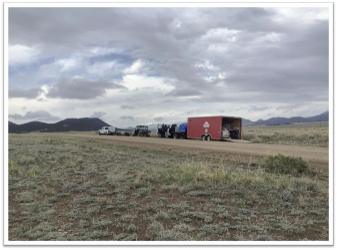
Figure 5. The Rosor Exploration geophysical crew has mobilized and arrived at the Silver Cliff Project survey area.
The Company has now completed its 2026 drill campaign and is advancing toward the next phase of exploration at Silver Cliff. Assays from all 2026 drill holes are currently pending and will be released once received, compiled and interpreted. In parallel, Rosor Exploration has mobilized to commence a district-scale geophysical survey designed to further define structural corridors and prioritize follow-up drill targets along the emerging Kate–Passiflora trend. The Company believes the integration of drilling, soil geochemistry and geophysical data will significantly enhance targeting as it continues to evaluate the broader district-scale hydrothermal system and the potential for deeper porphyry-related mineralization.
The Company also announces that its Board of Directors has approved the granting of 7,375,000 stock options to directors, management and consultants pursuant to the Company’s stock option plan. The options are exercisable at a price of $0.50 per share for a period of five years and remain subject to applicable regulatory approvals.
Quality Assurance/Quality Control (“QA/QC”) Measures, Chain of Custody
All Viscount’s drilling to date has been core. The Company has implemented a rigorous quality assurance/quality control program at the Silver Cliff project. Core is retrieved from the drill site to a locked storage facility, where it is logged on site by Christina Ricks, project geologist, and then cut by independent geologists. Half of the core is bagged, and standards, blanks and duplicates are frequently inserted into the sample stream. These are then boxed and shipped via USPS to Skyline Labs in Tucson, Arizona for sample preparation and analysis. Pulps and rejects will then be retrieved and stored with the split core at the Company’s locked facility.
Qualified Person
The scientific and technical information contained in this news release has been reviewed and approved by Harald Hoegberg, C. P.G., an independent consulting geologist who is a “Qualified Person” (QP) as such term is defined under National Instrument 43-101 — Standards of Disclosure for Mineral Projects (“NI 43-101”). On-site geological logging and field supervision of the 2026 program is being conducted by Christina Ricks, project geologist. Visual descriptions of drill core are qualitative observations only and are not a substitute for laboratory assay data. Mineral identifications made in hand-specimen are subject to confirmation by laboratory analysis. Readers are cautioned that mineralization observed in drill core may not be representative of the deposit as a whole, and that assay results, once received, may differ materially from visual estimates. Historic results are not necessarily indicative of mineralization that may be returned by the 2026 program.
About Viscount Mining Corp.
Viscount Mining Corp. is a project generator and mineral exploration company focused on advancing high-quality silver, gold and copper assets in the western United States. The Company’s portfolio includes the Silver Cliff silver project in Colorado and the Cherry Creek multi-metal district in Nevada.
Silver Cliff Project — Colorado
Silver Cliff is located in the historic Hardscrabble Silver District and comprises 96 lode claims with year-round paved access and established local infrastructure. The Project covers a large volcanic caldera system recognized for its silver, gold and base-metal potential, and contains two principal areas of focus:
- Kate Deposit (Silver Resource Area): the Kate deposit hosts a near-surface silver mineral resource estimated in accordance with NI 43-101 and prepared by an independent qualified person. Investors are encouraged to review the full technical report, available under the Company’s profile on SEDAR+ at sedarplus.ca, for resource categories, tonnes, grades and the assumptions and methodology on which the estimate is based.
- Passiflora Porphyry Target: historical and modern drilling indicate extensive hydrothermal alteration consistent with a large porphyry system. Drilling by Viscount in hole PF-23-03A intersected a 843.9-metre downhole interval of gold-copper mineralization, which the Company interprets as lying on the periphery of a potentially larger intrusive centre. The reported length is a downhole (core) length; true width has not been determined, and readers are referred to the Company’s news release dated [insert original release date] and its filings on SEDAR+ for the associated assay results and details. Mineralization remains open in multiple directions.
Cherry Creek Project — Nevada
Cherry Creek comprises 219 unpatented and 9 patented claims in a historic mining district approximately 50 miles north of Ely, Nevada. The property includes more than 20 past-producing mines and hosts several styles of mineralization, including silver-gold veins, carbonate-replacement (CRD) zones, jasperoids and porphyry-related alteration. The district is 100% controlled by Viscount and is considered prospective for multi-metal discoveries within the broader mineralized system.
For additional information regarding the above properties and other corporate information, please visit the Company’s website at www.viscountmining.com.
On Behalf of the Board of Directors
“Jim MacKenzie”
Jim MacKenzie President,
Chief Executive Officer and Director
For further information, please contact:
Viscount Investor Relations
Email: info@viscountmining.com
Neither the TSX Venture Exchange nor its Regulation Services Provider (as that term is defined in the policies of the TSX Venture Exchange) accepts responsibility for the adequacy or accuracy of this release.
Forward-Looking Statements
This news release contains certain “forward-looking statements” and “forward-looking information” within the meaning of applicable Canadian securities legislation. Forward-looking statements include, but are not limited to, statements regarding the Company’s exploration plans and objectives; the interpretation of drill results and the geological model at Silver Cliff; the potential size, continuity, grade and character of mineralization (including any porphyry-related mineralization); the expectation that assay results will be received, compiled and disclosed; and the potential of the Silver Cliff and Cherry Creek projects. Forward-looking statements are frequently identified by words such as “plans”, “expects”, “is expected”, “budget”, “scheduled”, “estimates”, “forecasts”, “intends”, “anticipates”, “believes”, or variations of such words, or statements that certain actions, events or results “may”, “could”, “would”, “might” or “will” be taken, occur or be achieved.
Forward-looking statements are based on assumptions management considers reasonable and are subject to known and unknown risks, uncertainties and other factors that may cause actual results to differ materially, including: that visual observations of mineralization may not be confirmed by assay; risks relating to exploration and development; the actual results of current and future exploration; the interpretation of geological data; changes in project parameters as plans are refined; commodity prices; the availability of financing; and the other risk factors described in the Company’s continuous disclosure filings available on SEDAR+ at www.sedarplus.ca. Although the Company has attempted to identify important factors that could cause actual results to differ materially, there may be other factors that cause results not to be as anticipated, estimated or intended. The Company does not undertake to update any forward-looking statements except as required by applicable law.
Stay In Touch